Estriol Vaginal Cream vs HRT Patches: What’s the Difference?

If you’re comparing estriol vaginal cream and HRT patches, you’re really comparing two different goals:
Local relief for vaginal + urinary menopause symptoms (cream used inside the vagina)
Whole-body relief for symptoms like hot flashes and night sweats (patch worn on the skin)
This guide breaks down the difference in plain language, plus the types of HRT patches you’ll see most often.
Educational only — not medical advice. Always follow your prescription label and your clinician’s guidance.
Quick answer (the “what do I actually need?” version)
Estriol vaginal cream is usually for local symptoms
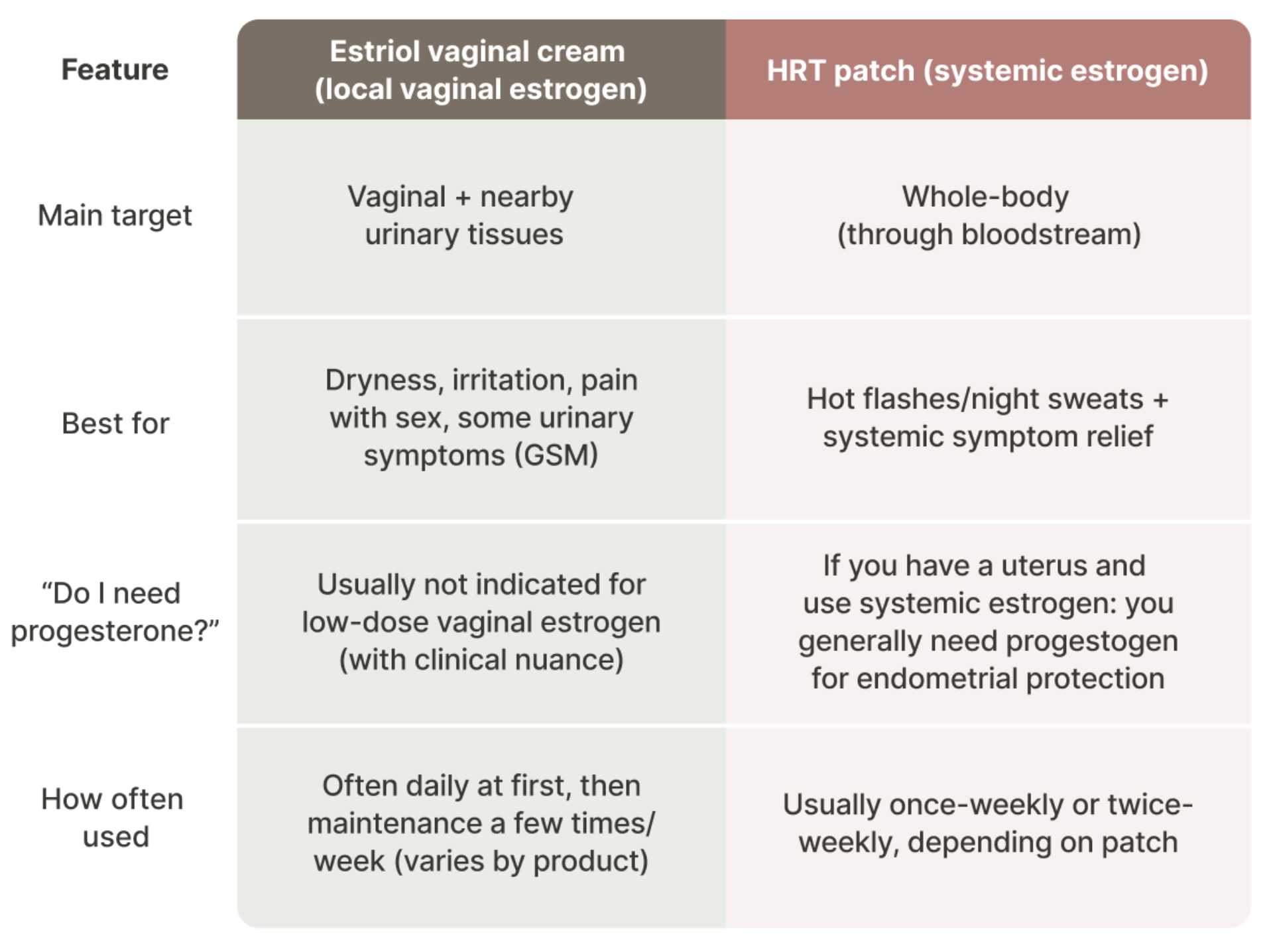
Think: vaginal dryness, burning/irritation, pain with sex, and some urinary symptoms that come from menopause-related tissue changes (often called GSM: genitourinary syndrome of menopause).
It’s typically considered low-dose vaginal estrogen, which is generally not meant to treat hot flashes or other whole-body symptoms.
HRT patches are usually for systemic (whole-body) symptoms
An estradiol patch is designed to release estrogen through your skin and into your bloodstream on a schedule (often once-weekly or twice-weekly).
Many people use both (yes, that’s a thing)
It’s common for someone to use systemic estrogen for hot flashes/night sweats and still need low-dose vaginal estrogen for persistent vaginal or urinary symptoms.
The core difference: where the medication is meant to work
Estriol vaginal cream = “local treatment”
Vaginal estrogen is designed to work mainly in the vaginal and nearby urinary tissues. In the NAMS GSM position statement, low-dose vaginal estrogen is described as having a more favorable risk profile than systemic estrogen because the doses are much lower, and blood levels generally stay in the postmenopausal range.
HRT patches = “systemic treatment”
Estradiol patches are designed to release estradiol continuously after you apply them to intact skin. Systemic hormone therapy is described by NAMS as the most effective treatment for vasomotor symptoms (hot flashes/night sweats) and also helps GSM in many cases.
What estriol vaginal cream is used for (and what it isn’t)
What it’s typically used for
Low-dose vaginal estrogen therapy is used for symptoms like:
vaginal dryness
discomfort/irritation
pain with sex
These are common reasons vaginal estrogen is prescribed for GSM.
What it usually isn’t used for
If your primary issues are:
hot flashes
night sweats
whole-body symptom relief
…those usually require systemic therapy (like a patch, pill, or systemic cream/gel), not a low-dose vaginal cream alone.
Do you need progesterone with estriol vaginal cream?
This question comes up constantly, so here’s the plain-language answer:
For low-dose vaginal estrogen, a progestogen is not indicated in general — but NAMS notes that endometrial safety data beyond 1 year is limited in clinical trials.
That’s different from systemic estrogen, where progesterone is commonly needed if you still have a uterus (more on that below).
What an HRT patch is used for (and why people like them)
What patches are commonly used for
NAMS describes hormone therapy as the most effective treatment for vasomotor symptoms (VMS) — like hot flashes and night sweats.
Why patches are often chosen
In the NAMS 2022 hormone therapy position statement, transdermal routes (like patches) and lower doses are noted as potentially decreasing risk of venous thromboembolism (blood clots) and stroke compared with other approaches.
(That’s not a guarantee for any individual person — it’s one factor clinicians weigh.)
Estriol vaginal cream vs HRT patches: side-by-side
Types of HRT patches (what “types of HRT patches” really means)
When people say “types of HRT patches,” they’re usually talking about one (or more) of these categories:
1) Estrogen-only patches vs combination therapy
Estrogen-only patches contain estradiol.
If you still have a uterus and you use systemic estrogen, NAMS explains that estrogen without progestogen can increase endometrial risk, so systemic estrogen users with an intact uterus should receive adequate progestogen (with some regimen exceptions).
Some people get progesterone separately (pill or other route), rather than in the patch itself.
2) Once-weekly vs twice-weekly patches
This is one of the biggest “type” differences, because it changes your routine:
Once-weekly patches are designed for a 7‑day wear period.
Twice-weekly patches are designed to be replaced twice per week (every 3–4 days).
Always follow the specific schedule on your prescription label.
3) Different strengths (dose options)
Patches come in different strengths so your clinician can match the dose to your symptoms and response.
Musely example: Our help center lists three estradiol patch options: Estradiol 0.025, Estradiol 0.05, and Estradiol 0.1 (your doctor decides what’s appropriate).
4) Different patch designs (you don’t need to memorize this)
Some patches are built differently (e.g., how the medication is held in the patch). That mostly matters for things like:
how well it sticks
skin irritation
why you should not alter the patch unless your pharmacist tells you it’s okay
(You don’t need to decide this yourself — your clinician/pharmacist handles the product-level details.)
Can you use estriol vaginal cream and an HRT patch at the same time?
Often, yes.
NAMS notes that for women with GSM, vaginal estrogen and systemic therapy (if required) may be used as needed, and low-dose vaginal estrogen is recommended when GSM symptoms aren’t relieved by over-the-counter options and systemic therapy isn’t otherwise indicated.
Translation: it’s normal for systemic therapy to help some symptoms but not fully solve vaginal dryness — adding local therapy is a common next step (clinician-directed).
How to choose: a symptom-based shortcut
If your #1 complaint is vaginal dryness, pain with sex, burning, or irritation
Start by asking about low-dose vaginal estrogen options.
If your #1 complaint is hot flashes/night sweats (and other whole-body symptoms)
Ask about systemic hormone therapy, including patches.
If you have both
You may end up with both: a systemic option for hot flashes + a local option for GSM.
Where Musely fits for HRT Benefits
Musely has prescription menopause treatments that include both patch and topical systemic cream options:
Musely’s Estrogen Patch
Applied twice a week and designed to deliver a stable dose of estradiol.
A transdermal form of HRT that delivers FDA-approved bioidentical estrogen through the skin for fast, effective relief from menopause and perimenopause symptoms.
Musely’s Estrogen Cream
A topical form of HRT that delivers bioidentical estrogen for fast, reliable relief from menopause and perimenopause symptoms.
Read our help center article that lists formulas that include estriol + estradiol (and sometimes progesterone, depending on uterus status and plan).
FAQs
Is estriol vaginal cream the same as an estrogen patch?
No. Vaginal cream is typically local, patch is systemic.
Will estriol vaginal cream help hot flashes?
Low-dose vaginal estrogen is primarily used for GSM (local symptoms). Hot flashes are typically treated with systemic therapy when appropriate.
Do I need progesterone?
Low-dose vaginal estrogen: progestogen is generally not indicated (with nuance).
Systemic estrogen (like patches): if you have a uterus, NAMS explains you generally need progestogen for endometrial protection.
Are there different types of HRT patches?
Yes. The main “types” are:
estrogen-only vs combination regimen (estrogen + progestogen plan)
once-weekly vs twice-weekly
different strengths
Products In This Tip

More tips like this

Guide to HRT/MHT
Does HRT Cause Cancer?

Guide to HRT/MHT
HRT Cream, Pills, and Pellets What You Need to Know

Guide to HRT/MHT
Choosing Your HRT: Cream, Patch, or Pill

Guide to HRT/MHT
Everything You Need To Know About The Estrogen Cream

Guide to HRT/MHT
Everything You Need To Know About The Estrogen Patch

Guide to HRT/MHT
Everything You Need To Know About The Estrogen Pill

Guide to HRT/MHT
Your Guide to HRT for Menopause

Guide to HRT/MHT